Insights Discovery
What is Insights Discovery? A complete guide to the four colour energies.
A practical, jargon-free guide to Insights Discovery — what it is, how it works, and how it helps individuals and teams understand each other better.
The Basics
What is Insights Discovery?
Insights Discovery is a behavioural profiling tool based on the psychology of Carl Jung. It helps individuals understand how they naturally communicate, make decisions and interact with others.
Unlike some personality assessments, Insights Discovery isn't about labelling people or putting them in boxes. It's about giving people practical language for understanding behaviour — their own, and everyone else's.
Each person who completes the Insights Discovery evaluator receives a personalised profile, often simply referred to as an Insights profile or colour profile. This document — typically 20+ pages — explores their communication style, strengths, potential blind spots, and how they tend to behave under pressure.
The Origins
The psychology behind Insights Discovery.
Insights Discovery is built on the work of Swiss psychiatrist Carl Jung, who proposed that people have consistent preferences for how they perceive the world and make decisions. Jung's theories on psychological type laid the groundwork for several well-known profiling tools used today.
What sets Insights Discovery apart is how it translates that theory into something genuinely usable in everyday work. Instead of abstract psychological terms, it uses four colour energies — language that's intuitive enough to remember in a meeting, but grounded in decades of established psychological research.
The Framework
The four colour energies.
Insights Discovery uses four colour energies to represent different behavioural preferences. Everyone has all access to all four energies — the difference lies in which ones each person uses most naturally and consciously bring with us to work.
Fiery Red
Decisive. Results-focused. Direct. Competitive. Strong-willed.
At their best
Decisive, driven, confident, competitive, determined
Under pressure
Can appear aggressive, controlling, or dismissive of process
Sunshine Yellow
Enthusiastic. Sociable. Optimistic. Persuasive. Creative.
At their best
Enthusiastic, creative, sociable, inspiring, optimistic
Under pressure
Can appear disorganised, unfocused, or overly talkative
Earth Green
Supportive. Empathetic. Patient. Consistent. Principled.
At their best
Calm, supportive, consistent, reliable, empathetic
Under pressure
Can appear passive, resistant to change, or indirect
Cool Blue
Analytical. Precise. Cautious. Questioning. Formal.
At their best
Precise, analytical, thorough, principled, objective
Under pressure
Can appear distant, overly critical, or slow to decide
Important: there are no good or bad colours.
Every colour energy brings genuine strengths — and every energy has a shadow side that can appear under stress. Insights Discovery doesn't rank or judge preferences. It simply helps people see patterns more clearly, so they can work with them rather than against them.
Curious about what your colour energy preferences might be? Click here to take our interactive quiz →
Behaviour in Context
Good day and bad day colours.
One of the most powerful aspects of Insights Discovery is understanding how each colour energy shows up differently depending on conditions. When people are energised, comfortable and supported, their strengths shine. Under stress or pressure, those same energies can manifest very differently.
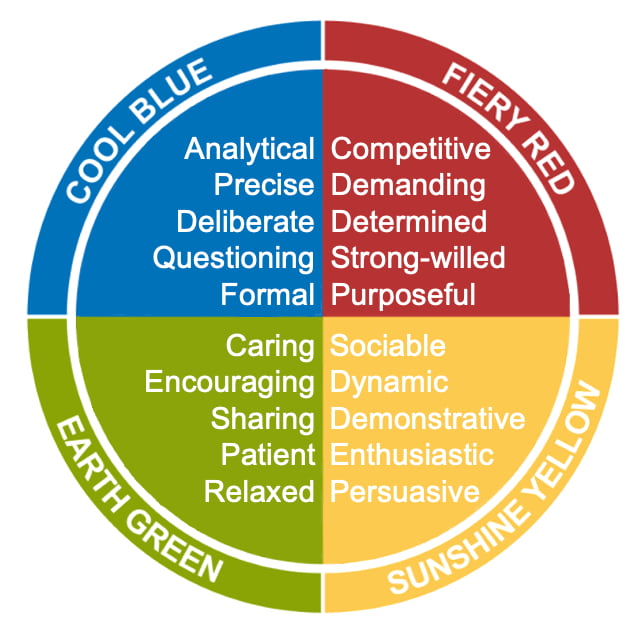
Good day colours
How each energy shows up when someone is at their best — energised, comfortable and performing well.
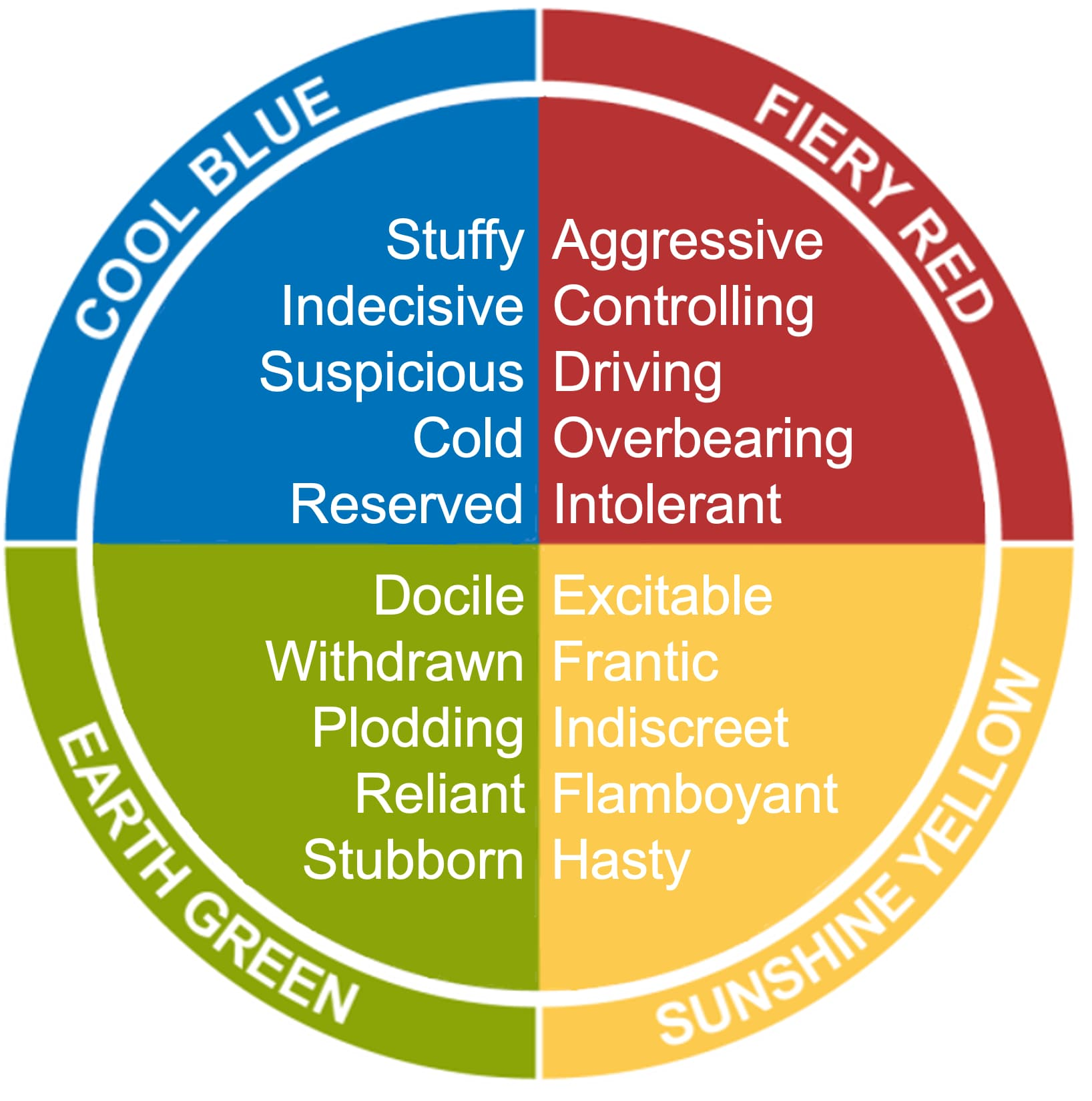
Bad day colours
How those same energies can manifest under stress or pressure — and what to watch out for in yourself and others.
Team Dynamics
The Insights Discovery team wheel.
Once a team has completed their Insights Discovery profiles, each person's position can be plotted on the team wheel. This gives a visual picture of where the team's collective energy sits — and where there are gaps.
A team clustered in one quadrant may be very cohesive but potentially blind to perspectives from other energies. A highly diverse team wheel brings range — but needs conscious effort to communicate across differences.
The team wheel typically forms the centrepiece of a team workshop, sparking conversations about how the group makes decisions, handles conflict, and communicates under pressure.
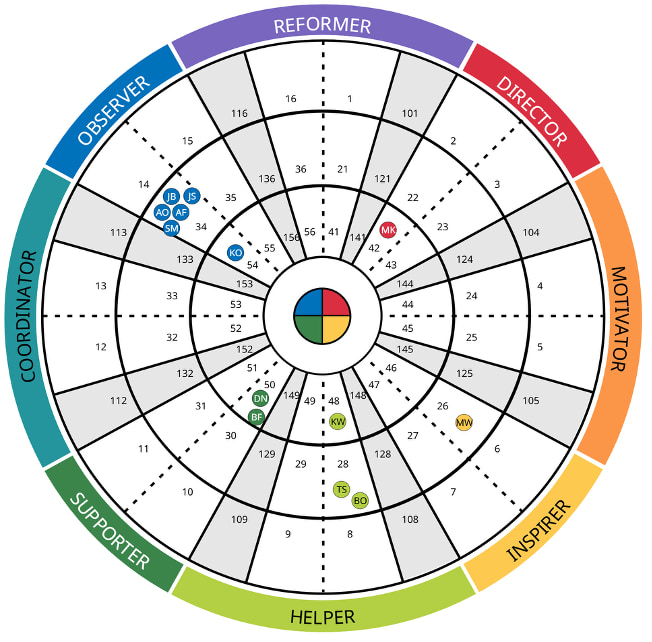
An example team wheel showing how individual profiles are distributed across the four colour energies.
The Profile
What Does an Insights Discovery Profile Include?
Every profile starts with the Foundation Chapter. Depending on what you need it for, additional chapters can be added to focus on specific contexts.
Foundation Chapter
The core of every profile. Covers self-awareness, how you interact with others, your decision-making style, your strengths, possible blind spots and your opposite type — the colour energy least like your own.
Management Chapter
Explores how you create the ideal working environment for yourself and others, your natural approach to managing people, and what genuinely motivates you and those you lead.
Effective Selling Chapter
Useful for client-facing roles. Looks at how your style shapes the way you influence others and build relationships throughout a sales or negotiation process.
Personal Achievement Chapter
A reflective chapter focused on your goals, what genuinely motivates you, and a personalised plan for your own development.
Interview Chapter
Helps you prepare for interviews with structured self-awareness, plus likely questions for use in recruitment and assessment exercises.
The Detail
What does an Insights Discovery profile tell you?
Communication styles
How you naturally prefer to give and receive information.
Strengths
The behaviours and qualities you bring most naturally to a team.
Blind spots
Patterns that may be less visible to you but clear to others.
Behaviour under pressure
How your style can shift when stressed or stretched.
How you interact with others
The dynamics that shape your working relationships.
Decision-making preferences
Whether you lean towards speed, analysis, consensus or instinct.
Want to have a one-to-one debrief? Learn more about Insights Discovery profile debriefs →
Applications
How Insights Discovery profiles are used.
Self-awareness
Recognising blind spots, understanding your behavioural impact on others, and building greater adaptability.
Team communication
Creating a common language for the team, adapting and connecting across different styles, and understanding different decision-making approaches.
Coaching
Providing a rich, structured starting point for one-to-one development conversations. Learn more about coaching.
Motivation
Understanding what genuinely drives you and others — rather than assuming everyone is motivated by the same things.
Resilience
Recognising your own patterns under pressure earlier, so you can respond more intentionally rather than purely on instinct.
Let's discuss using Insights Discovery with your team.
Tell us a little about your organisation and we'll be in touch.
Communication
How Insights Discovery improves communication.
Most communication breakdowns aren't really about the words being used. They're about mismatched styles — a direct communicator speaking to someone who needs more context, or a reflective thinker being rushed by someone who processes out loud.
Insights Discovery gives people a non-judgemental way to name those differences. Instead of "you're too blunt" or "you're too slow to decide", colleagues can say "I notice we're approaching this from different colour energies" — language that depersonalises friction and opens up a more productive conversation.
Team Development
Insights Discovery for team development.
Understanding your personal impact on the team
Adapting your communication to connect with different styles
Building trust across the group
Creating clarity in roles and expectations
Leading people with different personality types effectively
Want to bring this to your team? Take a look at our Insights Discovery workshops →
Business Impact
The ROI of Insights Discovery.
£15.52
According to Insights' ROI impact study, organisations see an average return of £15.52 for every £1 invested in Insights Discovery.
£7.5m
Global technology company Indeed reported over £7.5 million in cost savings after embedding Insights Discovery into onboarding and development programmes.
Common Questions
Frequently asked questions.
Not quite — and that distinction matters. A "test" implies right and wrong answers. Insights Discovery is a behavioural profiling tool that describes preferences, not a test you can pass or fail.
Both draw on Jungian theory, but they're different tools. Insights Discovery uses a simpler, more accessible colour-energy framework and is specifically designed for use in workplace contexts. Myers-Briggs produces 16 types; Insights Discovery uses four colour energies that everyone has in different proportions.
It depends what you need it for. Insights Discovery tends to be more accessible for team and workplace use than MBTI's 16-type model, while offering more depth than DISC's four-style framework. See our full comparison in the menu: Insights Discovery vs MBTI vs DiSC.
Most people find their profile strikingly accurate, often describing it as the first time they've seen their own communication patterns written down clearly. Accuracy depends on honest, instinctive responses to the evaluator — answering as you naturally are, rather than as you think you should be.
Your core preferences tend to be fairly stable, but circumstances, experience and context all have an influence. Many people find their profile shifts meaningfully if they retake it years later — particularly if they've been in a role that requires them to use non-preferred energies for a sustained period.
There's no expiry date on a profile, but most practitioners suggest revisiting it every few years — particularly after a significant career change, promotion or life event.
Good day colours show how someone behaves when they are at their best — energised, comfortable and performing well. Bad day colours show how the same energy can manifest under stress or pressure. Understanding both helps leaders and teams recognise warning signs and adapt before situations escalate.
The team wheel is a visual representation of where each team member's profile sits across the four colour energies. It shows at a glance where the team is concentrated, where there are gaps, and how different individuals are likely to interact. It's a powerful tool for understanding collective team dynamics.
Yes — in fact, Insights Discovery can be particularly valuable for remote teams where the absence of informal contact makes communication misunderstandings more likely. Having a shared language for preferences helps teams who rarely meet in person to understand each other better.
Most commonly for leadership development, team workshops, one-to-one coaching and onboarding. Organisations use it to build a shared language around communication and behaviour.
Interested in Insights Discovery for your team?
Let's have a conversation about how it could work in your organisation.
Book a call