Insights Discovery
Is Insights Discovery accurate?
Insights Discovery can be remarkably accurate at describing behavioural preferences, but it is not a complete description of your personality.
There is published evidence supporting the reliability and validity of the Insights Discovery Preference Evaluator. But understanding what that evidence means, and what it does not mean, is important. Insights Discovery does not measure intelligence, competence or potential, and it does not predict exactly how somebody will behave in every situation.
The Short Answer
Accurate does not mean complete.
Insights Discovery is a model of preference. It gives people a practical language for exploring how they communicate, make decisions and interact with others.
The useful question is not whether a computer-generated profile can capture every part of a complex human being. It cannot, and it should not be expected to.
A better question is: does the profile give you something accurate and useful enough to improve self-awareness, communication and adaptation?
Accuracy
How closely does the profile describe preferences and patterns you recognise in yourself?
Reliability
Does the evaluator produce reasonably consistent measurements when people complete it again?
Validity
Is there evidence that the evaluator measures the psychological constructs it claims to measure?
Personal Validation
How accurate is an Insights Discovery profile?
One of the simplest ways to explore accuracy is to treat the profile as the start of a conversation rather than a verdict.
At the beginning of the Personal Profile are a series of Personal Style statements. Participants can mark the statements that feel like them, then pay particular attention to those they reject.
Read the statements
Notice what feels immediately recognisable and what does not.
Mark the exceptions
Identify the statements you feel genuinely do not describe you.
Ask someone who knows you
Share the disputed statements with a trusted colleague, friend or partner.
Discuss the difference
Use any disagreement as useful data rather than trying to prove who is right.
The point is not: “The computer has told you who you are.” It is: “How accurately does this describe the person you recognise yourself to be?”
The Evidence
Is Insights Discovery scientifically valid?
Insights has an ongoing research and validation programme examining the reliability and validity of the Insights Discovery Preference Evaluator across languages and populations.
Published Insights research includes test-retest data showing strong consistency across the four colour energies, alongside research into internal reliability and construct validity.
That matters, but it is equally important not to overclaim what the research proves.
Insights Discovery reliability
Reliability asks whether a measure produces reasonably consistent results. Insights has published evidence examining the consistency of the Preference Evaluator over time.
Insights Discovery validity
Validity asks whether the evaluator is measuring the constructs it claims to measure. Insights reports research into construct validity as part of its ongoing validation programme.
What the research does not prove
Evidence supporting the evaluator does not mean four colour energies explain everything important about personality, predict performance or tell us exactly how somebody will behave in every situation.
A Crucial Distinction
You are not a colour.
Everyone has all four colour energies. The question is one of preference: which energies feel most natural, which are less preferred, and which you may be consciously bringing into your behaviour because your role or environment requires them.
Preference is not ability
Naturally preferring reflection does not mean you cannot become an excellent public speaker. A preference tells us what may feel more natural, not what you are capable of doing.
Preference is not behaviour
People adapt. Someone with a strong relational preference can still make tough decisions quickly when the situation requires it.
Preference is not destiny
Development is partly about becoming conscious enough of your preferences to stretch beyond them when another person or situation needs something different.
Behaviour in Context
Why might my Insights Discovery profile look different at work?
Your preferences do not operate in a vacuum. You also have a role, manager, team, customers, deadlines, culture and expectations. All of those can influence the version of you that other people experience at work.
Insights Discovery gives us a useful way to explore that through the Conscious Persona, Less Conscious Persona and Preference Flow.
01
Conscious Persona
This is a direct representation of how you responded to the evaluator. It can reflect how you are consciously showing up in your current environment.
02
Preference Flow
Preference Flow highlights movement between the two personas and can point to where you may be consciously boosting or restraining particular colour energies.
03
Less Conscious Persona
This is derived from the Conscious Persona using Jung's theory of psychological opposites. It can show your instinctive responses before conscious awareness.
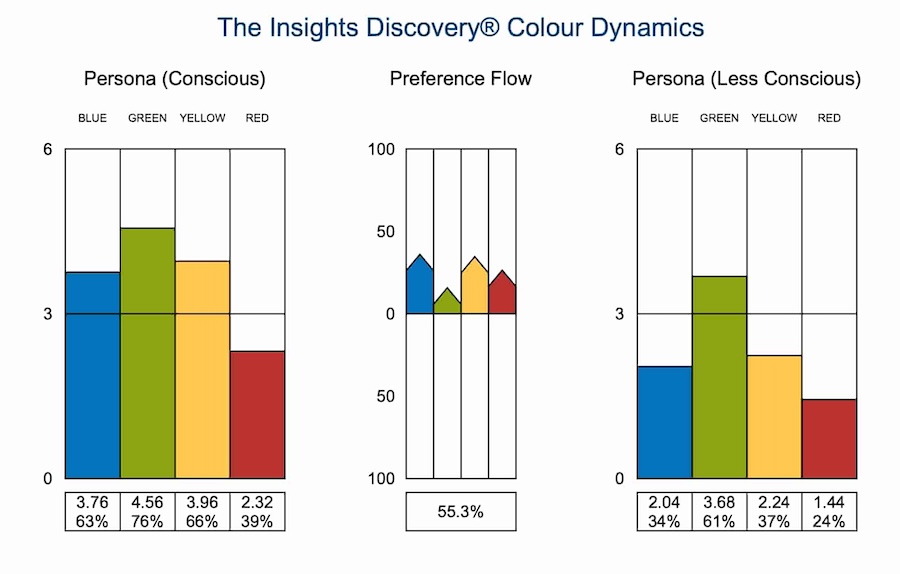
Example Insights Discovery Colour Dynamics showing the Conscious Persona, Preference Flow and Less Conscious Persona. The percentages shown belong to this example profile only.
The Important Bit
The graph can show that adaptation may be happening. It cannot tell us why.
Preference Flow is not a diagnosis and it is not something a practitioner should interpret in isolation. The meaning comes from exploring the graph with the individual.
A useful conversation might explore questions such as:
What do you think is creating that stretch?
Is it your role, environment, manager or team?
Is it something you have consciously developed?
How much energy does that adaptation take?
What might adaptation look like in practice?
Different roles and environments ask different things of us. Someone may consciously bring more of a colour energy into their behaviour because that is what the situation requires.
Fiery Red
A role demanding pace, challenge and quick decisions
Earth Green
Leadership requiring more listening, involvement and consideration
Cool Blue
An analytical environment requiring greater precision and detail
Sunshine Yellow
A client-facing role requiring more interaction and visible energy
The Limitations
What are the limitations of Insights Discovery?
Understanding the limitations of a model is part of using it well. The four colour energies are deliberately simple, and that simplicity can be both their strength and their risk.
“Four colours oversimplify personality.”
Yes. They are supposed to simplify it.
A useful model removes some complexity so that people can navigate it. The colour energies are a map, not the territory. Problems begin when the shorthand is mistaken for the whole person.
“Insights puts people into boxes.”
It can, if it is used badly.
Everyone has all four colour energies. Colour should create curiosity about somebody, not certainty. “You are Blue, so…” is very different from “I know detail can matter to you. What would be useful here?”
“But I behave differently at work.”
You probably do.
Preference and behaviour are not the same thing. Role, environment, culture and experience can all influence how other people experience us.
“Personality is more complicated than Jung.”
Absolutely.
Insights Discovery does not need to explain every aspect of human personality to be useful for the purposes it was designed for: self-awareness, communication and development.
Think of a map of the London Underground.
It dramatically simplifies London. Distances are distorted, streets and buildings disappear, and the city becomes a set of coloured lines. That does not make the map useless. It makes it useful for a particular purpose. The important thing is remembering that the map is not the full picture.
Use It Responsibly
What should Insights Discovery not be used for?
Insights Discovery is a learning and development tool. It is most useful when it opens conversations, not when it closes them.
It does not tell you:
Measuring intelligence
Judging whether somebody is good at their job
Predicting exactly how somebody will behave
Deciding what somebody is capable of
Selecting candidates on the basis of colour preference
Labelling people as a single personality type
It can help you explore:
Exploring communication preferences
Understanding different approaches to decisions
Recognising possible blind spots
Discussing adaptation and stretch
Making differences easier to talk about
Choosing how to communicate more consciously
The Real Test
So, does Insights Discovery actually work?
The most interesting question may not be whether a personality model has captured every aspect of your identity.
Has understanding your preferences helped you understand somebody else's? And has that awareness changed what you do?
Self-awareness without adaptation is just interesting information. The value comes when people start using what they have learned.
Listen differently
Recognise that somebody else may need a different pace, level of detail or style of involvement from you.
Ask better questions
Replace assumptions about somebody's colour with curiosity about what would help them most.
Communicate consciously
Adapt directness, pace, detail and involvement rather than communicating exclusively through your own preferences.
Connect across difference
Use the colour language as a shared starting point for discussing friction without making either person wrong.
Other Models
How does Insights Discovery compare with other personality assessments?
Insights Discovery is not the only framework available. MBTI also draws on Jungian theory, while DiSC has different theoretical roots. The most useful comparison is not simply which model is “best”, but what you want people to understand and do differently afterwards.
Insights Discovery
Jungian preferences translated into four memorable colour energies for practical workplace use.
MBTI
A Jungian type framework built around four preference dichotomies and 16 personality types.
DiSC
A behavioural style framework with different theoretical origins and a different way of describing observable behaviour.
Make Your Own Mind Up
Experience your own Insights Discovery profile.
The most useful way to judge the profile is to experience it, question it and explore it with a qualified practitioner.
Common Questions
Insights Discovery accuracy FAQs.
Many people recognise a great deal of themselves in their Insights Discovery profile, but it should be treated as a starting point for reflection rather than a definitive description of who you are. The profile describes behavioural preferences, not every aspect of your personality.
Yes. Insights has an ongoing research and validation programme examining the reliability and validity of the Insights Discovery Preference Evaluator across different languages and populations. That supports its use as a measure of preference, but does not mean it can predict exactly how somebody will behave.
Published research has found strong consistency when people complete the evaluator again over time. That suggests the Preference Evaluator measures preferences with a useful degree of reliability, although no personality or behavioural model should be treated as a perfect description of an individual.
That is worth exploring rather than dismissing. Your role, environment and current circumstances can influence how you answer the evaluator, and some statements may describe patterns that other people notice more readily than you do. A good debrief explores both what resonates and what does not.
Yes. Your underlying preferences may be relatively stable, but your conscious behaviour can change with experience, role and environment. If you complete the evaluator again after a significant change in circumstances, some movement would not necessarily be surprising.
It can if it is used badly. Everyone has all four colour energies, so somebody should never be reduced to a single colour. The colours are intended to create a shared language for exploring differences, not labels that define what somebody can or cannot do.
No. It describes preferences rather than predicting behaviour. People adapt to different situations, roles and relationships, so preference can help explain what may feel natural without telling you exactly what somebody will do.
Preference Flow describes the movement between a person's Conscious Persona and Less Conscious Persona. It can provide a useful starting point for exploring where somebody may be consciously boosting or restraining particular colour energies, although only the individual can explain why that movement exists.
Insights Discovery should not be used to select or reject candidates based on colour preference. Preference is not the same as competence, ability or potential. Its value is primarily in learning, self-awareness, communication and development.
Want to explore Insights Discovery for yourself or your team?
Tell us a little about what you are looking to achieve and we will be in touch.